
ROI Calculator (Return on Investment)
This free ROI calculator measures the return on any investment – shares, property, a business project or a marketing campaign. Enter what you put in and what you got back to see the profit, total ROI and the annualized return per year.
Your result
What is ROI?
ROI, or return on investment, measures how much you gained or lost compared with what you put in, as a percentage. Because it works for anything with a cost and a payoff, ROI is used for shares, property, equipment, education and marketing campaigns alike. An ROI calculator saves you the arithmetic and also turns the result into a yearly rate.
How to use this ROI calculator
- Enter the amount invested, including fees and costs.
- Enter the amount returned – the sale price or current value plus any income received.
- Enter how many years you held it to compare investments of different lengths.
ROI formulas
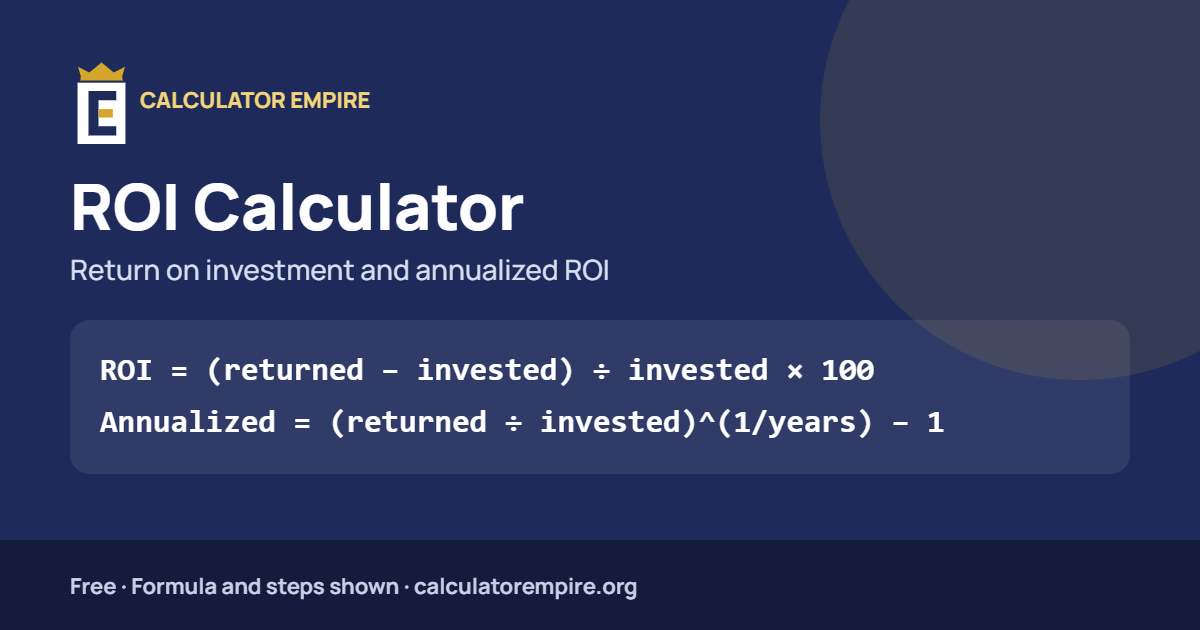
ROI = (amount returned − amount invested) ÷ amount invested × 100
Annualized ROI = (amount returned ÷ amount invested)1 ÷ years − 1
Total ROI does not account for time: 50% over 2 years is far better than 50% over 10 years. Annualized ROI (also called CAGR) turns any result into a yearly rate so you can compare fairly.
ROI calculator example
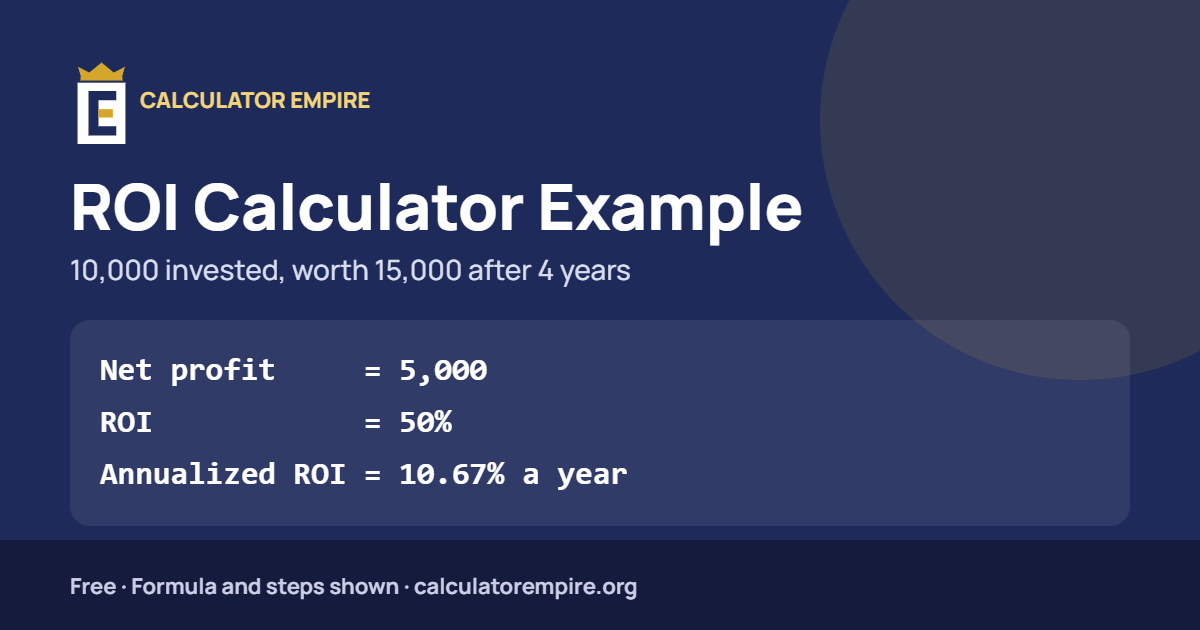
You invest 10,000 and four years later it is worth 15,000:
- Profit = 15,000 − 10,000 = 5,000
- ROI = 5,000 ÷ 10,000 = 50%
- Annualized = 1.51/4 − 1 ≈ 10.67% a year
A loss example
If 10,000 falls to 8,000, ROI = (8,000 − 10,000) ÷ 10,000 = −20%.
A marketing example
An advertising campaign costs 2,000 and produces 5,000 of extra gross profit. Marketing ROI = (5,000 − 2,000) ÷ 2,000 = 150%.
Comparing two investments
| Investment | Total ROI | Years | Annualized ROI |
|---|---|---|---|
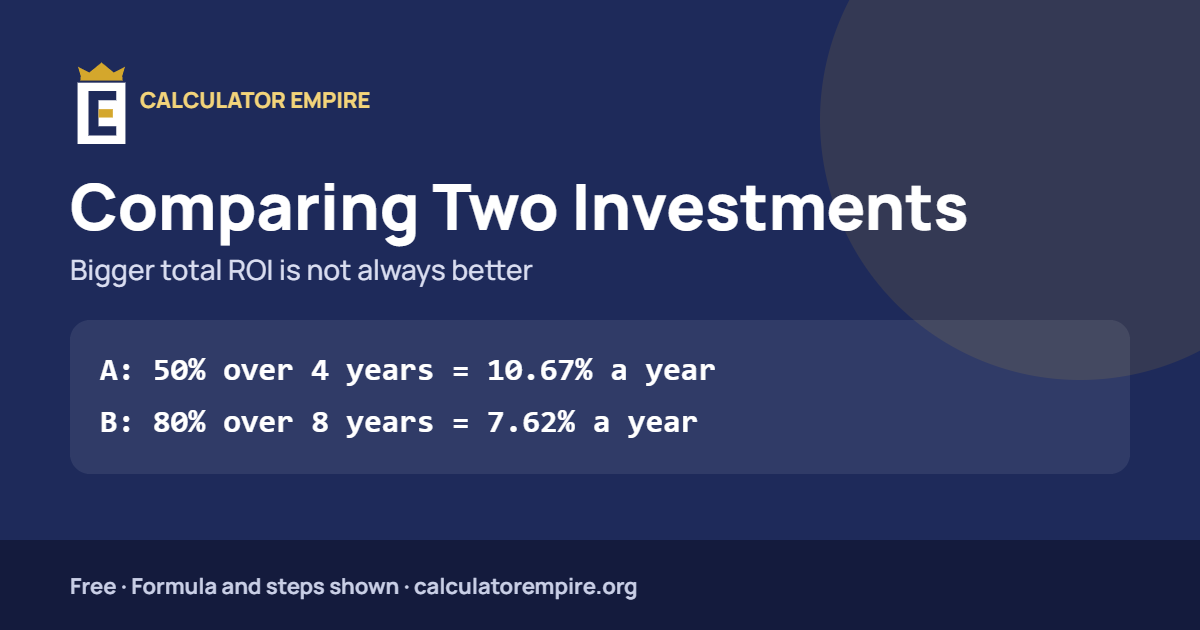
| A | 50% | 4 | 10.67% |
| B | 80% | 8 | 7.62% |
Investment B has the bigger total ROI but A grew faster each year. That is why the ROI calculator shows both numbers.
What counts as a good ROI?
There is no single answer. Compare an investment’s annualized ROI with what you could earn at low risk – a savings account or government bond in your country – and with inflation. Riskier investments should offer higher expected returns to be worth it.
Limits of ROI
- It ignores risk: two investments with the same ROI can have very different chances of loss.
- Simple ROI ignores time unless you annualize it.
- It depends on counting every cost; missing fees or taxes inflates the result.
- For uneven cash flows over many years, measures such as IRR are more precise.
Include every cost (brokerage, taxes, maintenance, advertising) in the amount invested, or your ROI will look better than it really is.
Frequently asked questions
How do you calculate ROI?
Subtract the amount invested from the amount returned, divide by the amount invested and multiply by 100.
What is a good ROI?
It depends on the risk and time involved. Compare an investment’s annualized ROI with safer options such as savings accounts or government bonds in your country.
Can ROI be negative?
Yes. If you get back less than you put in, ROI is negative and shows the percentage lost.
What is the difference between ROI and annualized ROI?
ROI is the total gain over the whole period. Annualized ROI spreads that gain into an equivalent yearly rate with compounding.
Is annualized ROI the same as CAGR?
Yes. For a single amount invested and a single final value, annualized ROI and compound annual growth rate (CAGR) are the same.
How do I calculate marketing ROI?
Use the extra gross profit the campaign produced as the return and the full campaign cost as the investment: (profit − cost) ÷ cost.
Should dividends or rent be included?
Yes. Add income received during the investment to the amount returned.
What is the difference between ROI and ROE?
ROI measures the return on a specific investment. ROE (return on equity) measures a company’s profit relative to shareholders’ equity.
Does ROI include inflation?
No. To see the real return, compare the annualized ROI with inflation using the Inflation Calculator.
What is the difference between ROI and profit margin?
ROI compares profit with the money invested. Profit margin compares profit with sales revenue.
Sources
Related calculators
- Compound Interest Calculator
- Profit Margin Calculator
- Inflation Calculator
- Savings Goal Calculator
- All Finance Calculators
Spotted an error? Tell us and we will check it.