
Inflation Calculator
This free inflation calculator shows how inflation changes what money is worth. Find what today’s cost will be in the future, and what a future amount is worth in today’s money, using any yearly inflation rate.
Your result
What is inflation?
Inflation is the general rise in prices over time. When prices rise, each unit of money buys less, so its purchasing power falls. Central banks track inflation with a consumer price index (CPI) – the cost of a typical basket of goods and services – and many aim to keep it around 2% a year, although actual rates can be much higher.
An inflation calculator turns a yearly rate into something concrete: how much a price will rise, and how much a fixed sum of money will really be worth in the future.
How to use this inflation calculator
- Enter an amount – a price today, or a sum you will have in the future.
- Enter an average yearly inflation rate.
- Enter the number of years.
- The first result shows what the same goods will cost later; the second shows what that amount will really be worth in today’s money.
Inflation formulas
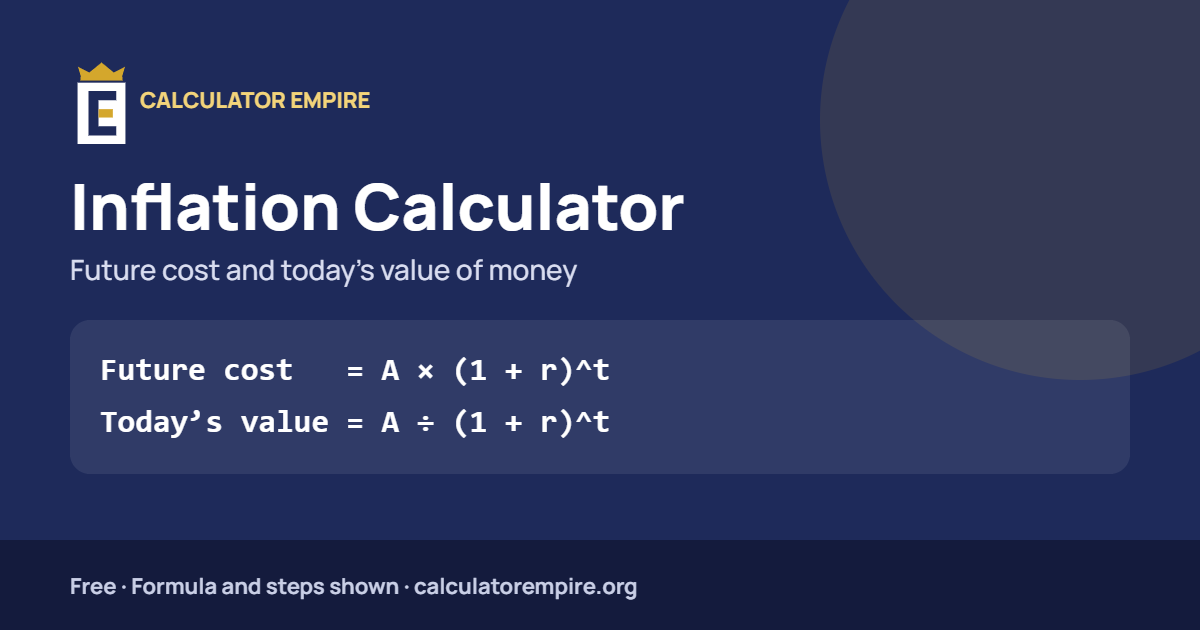
Future cost = A × (1 + r)t
Today’s value = A ÷ (1 + r)t
- A = amount
- r = yearly inflation rate as a decimal (3% = 0.03)
- t = number of years
Inflation calculator example
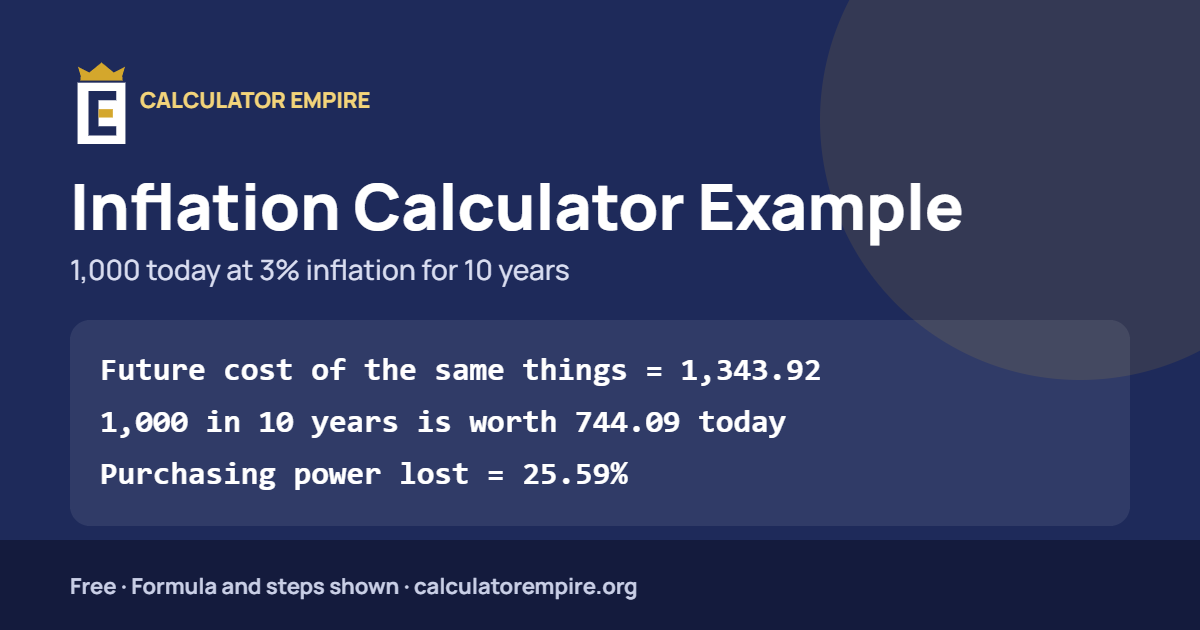
Something costs 1,000 today and inflation averages 3% a year for 10 years:
- 1.0310 ≈ 1.3439
- Future cost ≈ 1,343.92 – prices rise about 34.4%
- 1,000 received in 10 years is worth only about 744.09 in today’s money
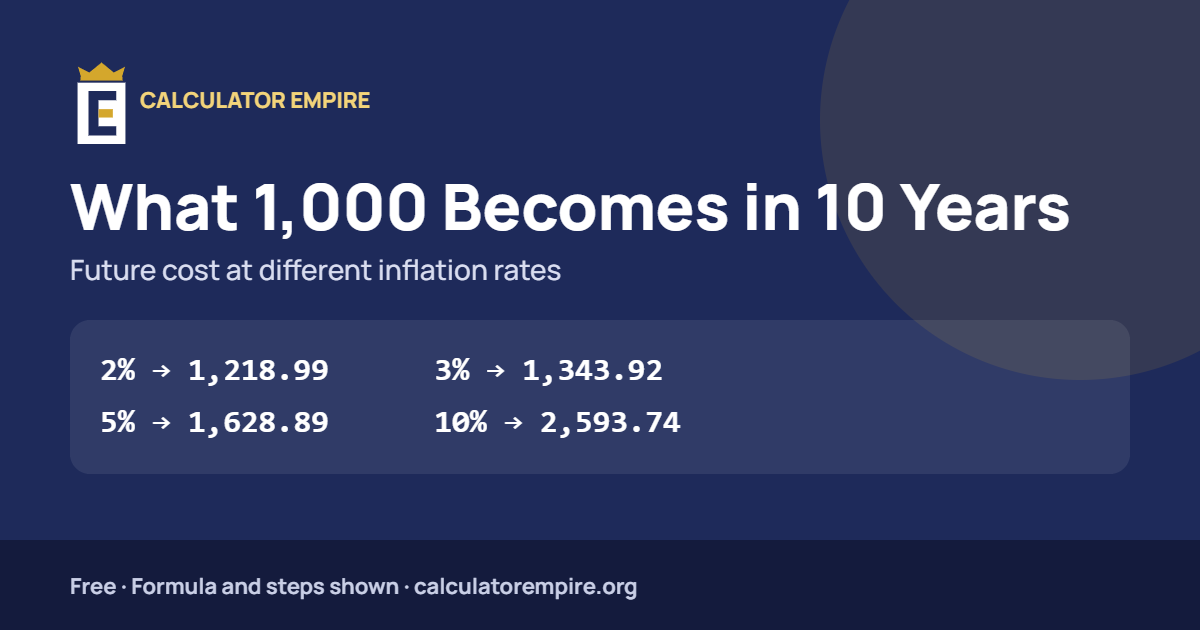
How much prices rise at different inflation rates
| Inflation rate | Cost of 1,000 after 10 years | Value of 1,000 in 10 years (today’s money) |
|---|---|---|
| 2% | 1,218.99 | 820.35 |
| 3% | 1,343.92 | 744.09 |
| 5% | 1,628.89 | 613.91 |
| 10% | 2,593.74 | 385.54 |
Real return: inflation and your savings
If your savings earn less than the inflation rate, their real value falls even though the balance grows. The real return is roughly the interest rate minus inflation; more precisely (1 + rate) ÷ (1 + inflation) − 1. A 6% return with 3% inflation is a real return of about 2.91%. Compare your rate with inflation using the Compound Interest Calculator.
The Rule of 70 for prices
Divide 70 by the inflation rate to estimate how many years it takes for prices to double. At 3% inflation prices double in about 23 years; at 10% in about 7 years.
How to protect your money from inflation
- Keep only short-term needs in cash or low-interest accounts.
- Invest long-term savings in assets that have historically beaten inflation.
- Plan goals in future money – use the Savings Goal Calculator with an inflated target.
- Ask for pay rises that at least match inflation.
This calculator uses a constant average rate. Actual inflation changes every year; for exact historical comparisons use official consumer price index (CPI) data for your country.
Frequently asked questions
What is inflation?
Inflation is the general rise in prices over time, which means the same amount of money buys less.
How is inflation calculated?
Statistics offices compare the price of a fixed basket of goods and services over time. The percentage change in that index is the inflation rate.
What inflation rate should I use?
Use the recent average for your country from its statistics office or central bank. Many central banks target about 2% a year, but actual rates can be much higher.
What is purchasing power?
Purchasing power is how much a unit of money can buy. When prices rise 10%, the purchasing power of money falls by about 9.1%.
How do I calculate the future value of money with inflation?
Multiply today’s price by (1 + inflation rate) raised to the number of years. 1,000 at 3% for 10 years becomes about 1,343.92.
How do I find today’s value of a future amount?
Divide the future amount by (1 + inflation rate) raised to the number of years.
What is the difference between nominal and real value?
Nominal value is the number of currency units. Real value adjusts for inflation and shows what that money can actually buy.
Can I calculate past inflation with this?
You can estimate it with an average rate. For exact past figures use the official CPI series, since rates differ from year to year.
Why does inflation matter for retirement planning?
Costs decades from now will be much higher, so a savings target set in today’s money will fall short unless you allow for inflation.
Is deflation possible?
Yes. Enter a negative rate to see what falling prices would do, although sustained deflation is rare.
Sources
Related calculators
- Compound Interest Calculator
- Savings Goal Calculator
- ROI Calculator
- Salary to Hourly Calculator
- All Finance Calculators
Spotted an error? Tell us and we will check it.