
Savings Goal Calculator
This free savings goal calculator shows how much you need to save each month to reach a goal – a house deposit, a car, Hajj, a wedding or an emergency fund – by a set date, including the interest your savings earn along the way.
Your result
What is a savings goal calculator?
A savings goal calculator works backwards from a target. You tell it how much you want, how much you already have, the interest your money earns and your deadline; it tells you the monthly amount to set aside. Turning a big number into a monthly figure makes any goal easier to plan and track.
How to use this savings goal calculator
- Enter your savings goal.
- Enter what you have already saved towards it.
- Enter the interest rate your savings earn (0 is fine).
- Enter how many years you have. The result is the monthly amount to save, with a yearly progress table.
Savings goal formula
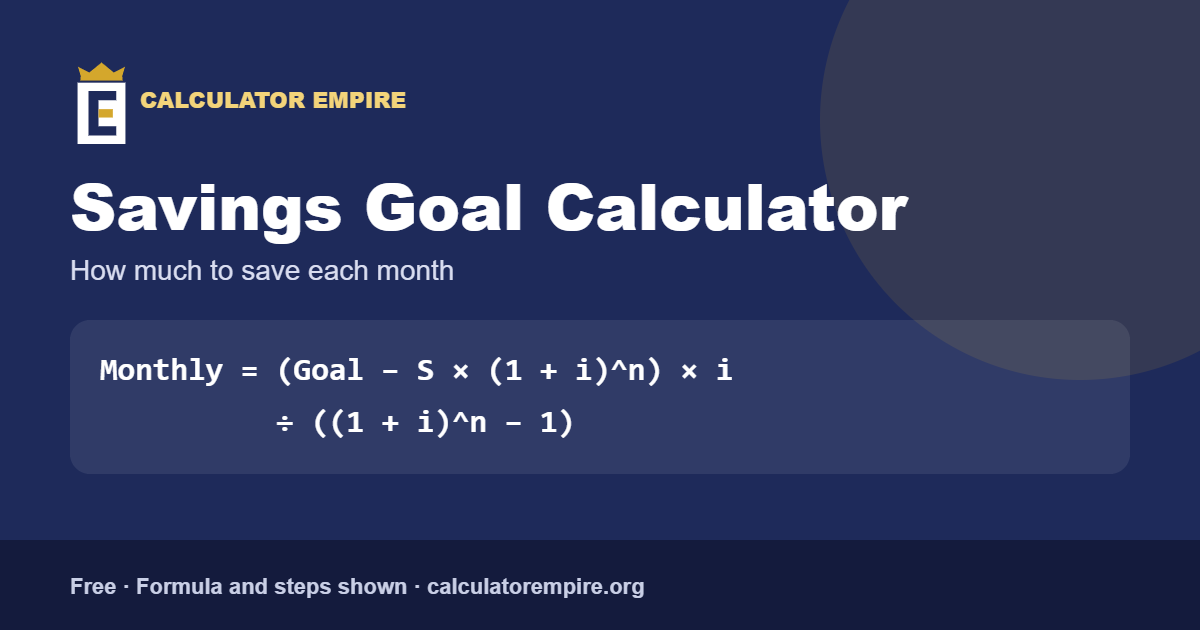
Your current savings grow on their own; the monthly deposit only has to cover the gap. With deposits at the end of each month:
Monthly deposit = (Goal − S × (1 + i)n) × i ÷ ((1 + i)n − 1)
- S = amount already saved
- i = yearly rate ÷ 12 ÷ 100
- n = number of months
- If the rate is 0: monthly deposit = (Goal − S) ÷ n
Savings goal calculator example
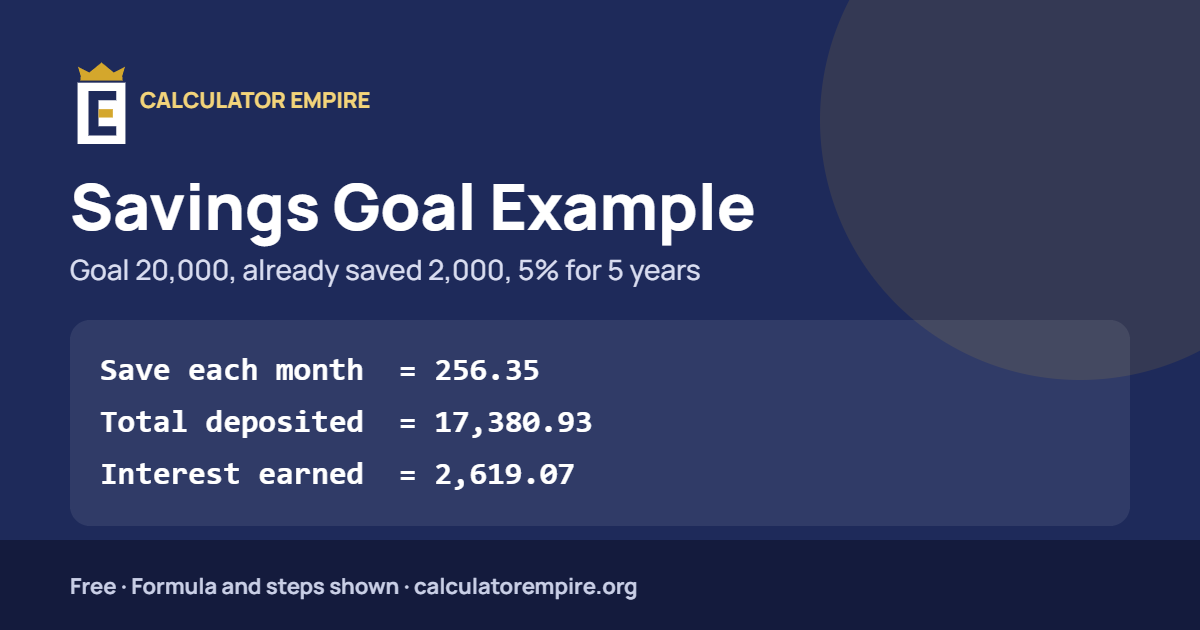
Goal 20,000, already saved 2,000, 5% a year, 5 years (60 months):
- 2,000 grows to about 2,566.72
- Still needed ≈ 17,433.28
- Monthly deposit ≈ 256.35
- You deposit about 17,381 in total; interest covers the rest
How much to save per month for 20,000
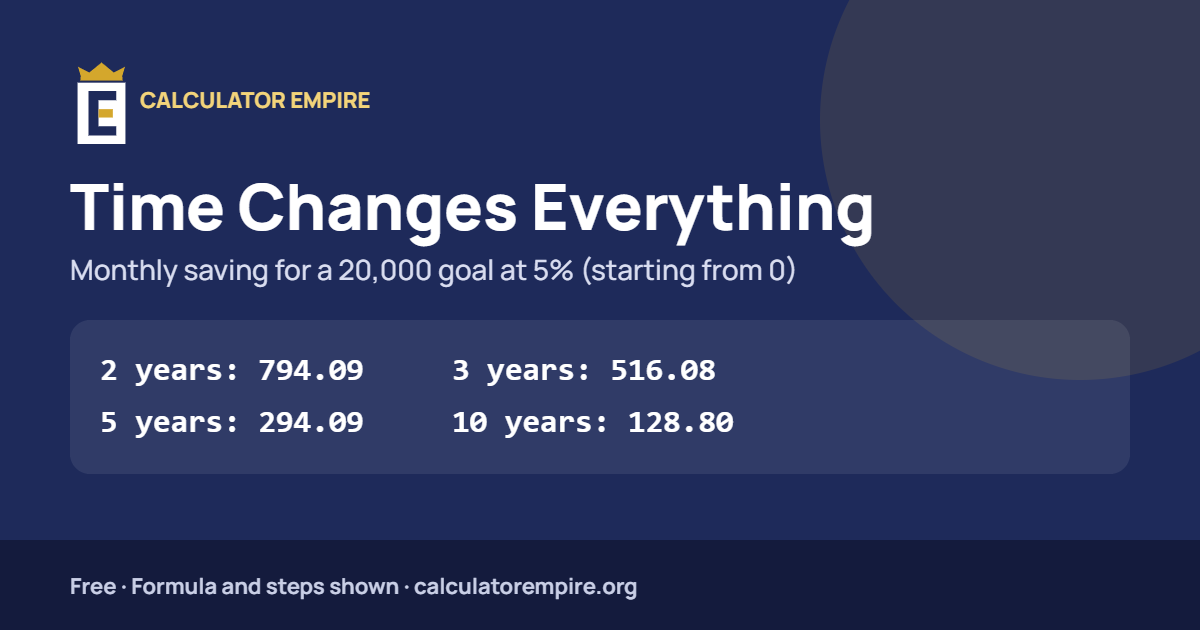
| Time | Monthly saving at 5% (starting from 0) |
|---|---|
| 2 years | 794.09 |
| 3 years | 516.08 |
| 5 years | 294.09 |
| 10 years | 128.80 |
Doubling the time from 5 to 10 years cuts the monthly amount by more than half, because interest has longer to work and the deposits are spread over more months.
Common savings goals
- Emergency fund – 3 to 6 months of essential expenses in an easy-access account.
- House deposit – often 10–20% of the price plus closing costs; see the Mortgage Calculator.
- Car – saving the full price avoids interest; compare with the Auto Loan Calculator.
- Hajj, Umrah, wedding or education – set the deadline and save monthly.
- Retirement – a long-term goal where investment growth matters most.
Tips to reach your goal faster
- Set up an automatic transfer on payday so saving happens first.
- Keep short-term goals in a safe, easy-to-reach account; take investment risk only for long-term goals.
- Raise the monthly amount whenever your income goes up.
- Save windfalls such as bonuses and gifts.
- Check the effect of inflation on your goal with the Inflation Calculator.
Frequently asked questions
How much should I save each month?
Enough to reach your goal by your deadline – that is what the savings goal calculator works out. A common rule for general saving is to put away at least 10–20% of take-home pay.
How is the monthly savings amount calculated?
The calculator grows your current savings to the deadline, finds the remaining gap and spreads it over the months using the future value of a regular deposit.
Does interest make a big difference?
Over a few years at savings-account rates it helps a little; over 10 years or more it can cover a large share of the goal.
How much should be in an emergency fund?
Most guidance suggests 3 to 6 months of essential living costs, kept somewhere you can reach quickly.
What if I already have enough?
If your current savings will grow past the goal by the deadline, the calculator shows that no extra deposits are needed.
Are deposits made at the start or end of the month?
This calculator assumes the end of each month. Saving at the start of the month would need slightly less.
Should I save or pay off debt first?
Build a small emergency fund first, then focus on high-interest debt such as credit cards, which usually costs more than savings earn.
How do I save for a goal 10 years away?
For long goals, consider investments with higher expected returns and allow for inflation by raising your target.
What is the 50/30/20 rule?
A simple budget: about 50% of take-home pay for needs, 30% for wants and 20% for savings and debt repayment.
Can I use this calculator in rupees or other currencies?
Yes. Choose your currency from the list; the maths works the same in every currency.
Sources
Related calculators
- Compound Interest Calculator
- Inflation Calculator
- ROI Calculator
- Simple Interest Calculator
- All Finance Calculators
Spotted an error? Tell us and we will check it.