
Compound Interest Calculator
This free compound interest calculator shows how your savings or investment grows when interest earns interest. Enter a starting amount, an optional monthly deposit, the yearly rate and how often it compounds to get the future value and a year-by-year growth table.
Your result
What is compound interest?
Compound interest is interest calculated on the original amount and on the interest already added. Each period, the interest joins the balance and starts earning interest itself. That is why savings and investments grow slowly at first and much faster later – the growth curve gets steeper every year.
A compound interest calculator does the repeated multiplication for you, so you can see the future value of your money under different rates, deposits and time frames.
How to use this compound interest calculator
- Enter your starting amount (principal).
- Add a monthly deposit if you plan to keep saving; leave it at 0 for a one-time investment.
- Enter the yearly interest rate or expected return and the number of years.
- Choose how often interest is compounded. The result, chart and table update as you type.
Compound interest formula
For a single deposit, the future value is:
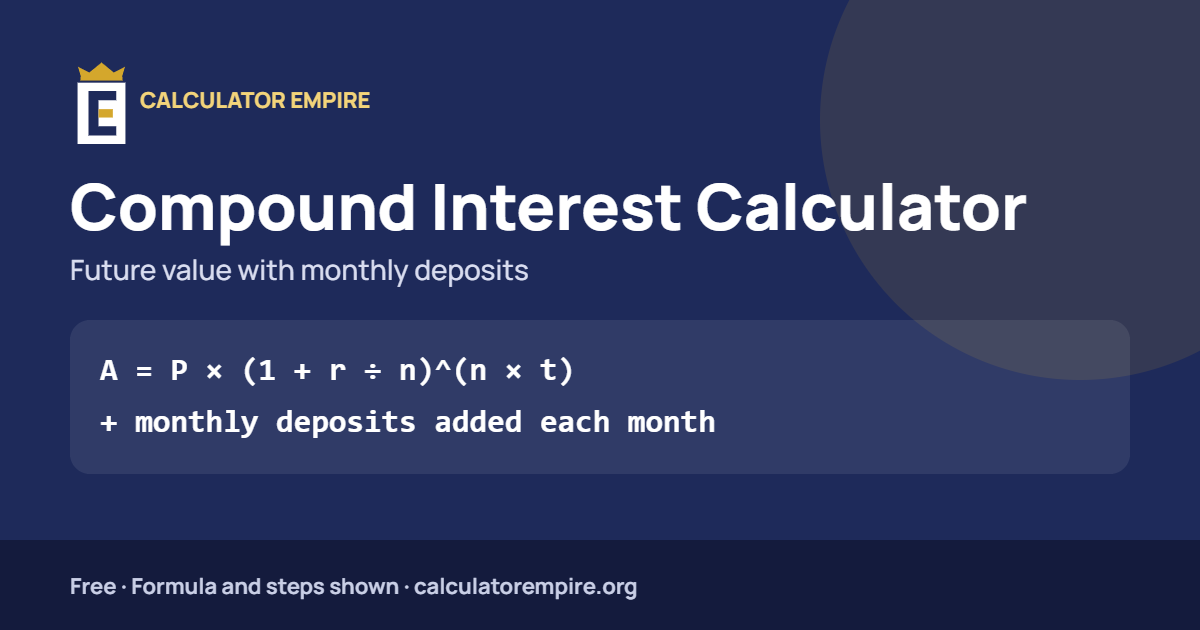
A = P × (1 + r ÷ n)n × t
- A = amount after t years
- P = starting amount
- r = yearly rate as a decimal (8% = 0.08)
- n = compounding periods per year
- t = years
With regular monthly deposits, each deposit grows for the months left until the end. The compound interest calculator adds them month by month, converting the yearly rate to an equivalent monthly rate so any compounding frequency works.
Compound interest calculator worked example
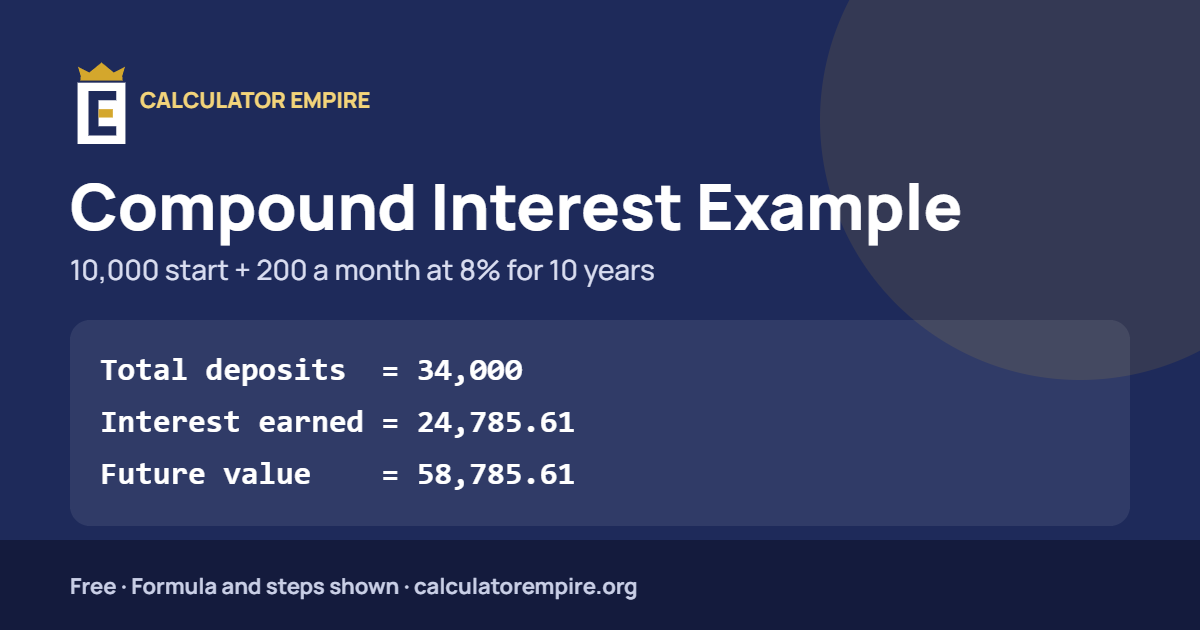
Start with 10,000, add 200 every month, earn 8% a year compounded monthly, for 10 years:
- Total deposits = 10,000 + 200 × 120 = 34,000
- Future value ≈ 58,785.61
- Interest earned ≈ 24,785.61 – more than 70% on top of what you put in
Does compounding frequency matter?
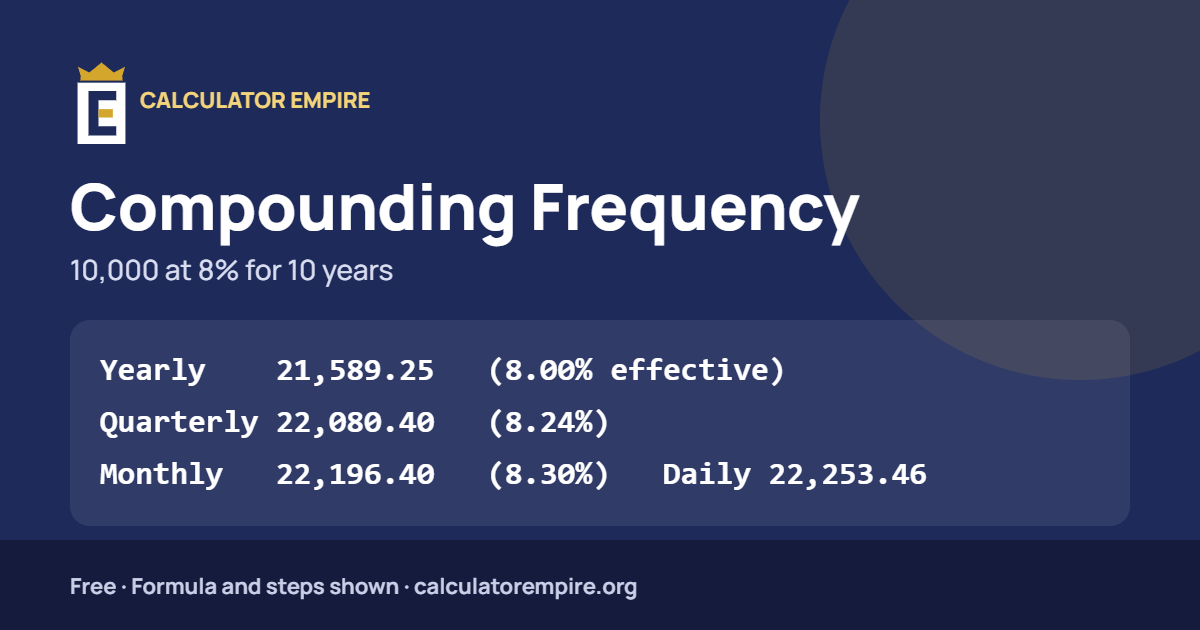
| Compounding | Value of 10,000 after 10 years at 8% | Effective annual rate |
|---|---|---|
| Yearly | 21,589.25 | 8.00% |
| Quarterly | 22,080.40 | 8.24% |
| Monthly | 22,196.40 | 8.30% |
| Daily | 22,253.46 | 8.33% |
More frequent compounding helps, but the difference between monthly and daily is small. The rate and the time you stay invested matter far more.
Simple vs compound interest
| Years | Simple interest (8%) | Compound interest (8%, yearly) |
|---|---|---|
| 5 | 14,000.00 | 14,693.28 |
| 10 | 18,000.00 | 21,589.25 |
| 20 | 26,000.00 | 46,609.57 |
After 20 years, compounding turns 10,000 into almost twice what simple interest gives. See the Simple Interest Calculator for loans and deposits that do not compound.
The Rule of 72
Divide 72 by the yearly rate to estimate how many years it takes to double your money.
| Rate | Years to double (approx.) |
|---|---|
| 4% | 18 |
| 6% | 12 |
| 8% | 9 |
| 10% | 7.2 |
| 12% | 6 |
How to make compound interest work for you
- Start early – time is the most powerful part of the formula.
- Add regular monthly deposits, even small ones.
- Reinvest interest and dividends instead of withdrawing them.
- Keep fees low; a 1% yearly fee also compounds against you.
- Compare your rate with inflation using the Inflation Calculator.
Returns on investments such as stocks or funds are not guaranteed and change from year to year. Use a conservative rate when planning.
Frequently asked questions
What is compound interest?
Compound interest is interest calculated on both the original amount and the interest already added, so savings grow faster than with simple interest.
How do you calculate compound interest?
Use A = P × (1 + r/n)^(n × t), where P is the principal, r the yearly rate, n the compounding periods per year and t the years. Subtract P to get the interest.
Does compounding frequency matter much?
A little. At 8%, yearly compounding gives an effective rate of 8.00%, monthly 8.30% and daily about 8.33%. Time and the rate matter far more.
Are deposits added at the start or end of the month?
This compound interest calculator adds monthly deposits at the end of each month, the common convention for savings plans.
How long does it take to double my money?
Use the Rule of 72: divide 72 by the yearly rate. At 6% it takes about 12 years; at 9% about 8 years.
What is the effective annual rate (EAR)?
The EAR is the yearly rate after compounding is included. For 8% compounded monthly it is about 8.30%.
Is compound interest good or bad?
It is good when you are saving or investing and bad when you owe money, for example on credit cards, where unpaid interest also compounds.
What is continuous compounding?
It is the limit of compounding infinitely often, A = P × e^(r × t). The result is only slightly above daily compounding.
Can I use it for loans?
It shows how a debt grows if nothing is repaid, but for loans with payments use the Loan Calculator.
What rate should I use for investments?
Use a realistic long-term average after fees, and test a lower rate too. Past returns do not guarantee future results.
Sources
Related calculators
- Simple Interest Calculator
- Savings Goal Calculator
- ROI Calculator
- Inflation Calculator
- All Finance Calculators
Spotted an error? Tell us and we will check it.