
Simple Interest Calculator
This free simple interest calculator finds the interest and total amount from the principal, yearly rate and time in years, months or days. Useful for short-term loans, deposits that pay interest out, and school maths problems.
Your result
What is simple interest?
Simple interest is interest charged or earned only on the original amount of money, called the principal. It does not include interest on interest, so the amount added each year stays the same. Because the maths is straightforward, simple interest is common for short-term loans, some car loans, treasury bills and in school arithmetic.
How to use this simple interest calculator
- Enter the principal – the amount borrowed or deposited.
- Enter the yearly interest rate.
- Enter the time and choose years, months or days.
- Read the interest and the total amount. The simple interest calculator shows its working under the result.
Simple interest formula
I = P × R × T
A = P + I
- I = simple interest
- P = principal
- R = yearly rate as a decimal (9% = 0.09)
- T = time in years (months ÷ 12, or days ÷ 365)
- A = total amount at the end
Finding the other values
- Rate: R = I ÷ (P × T)
- Time: T = I ÷ (P × R)
- Principal: P = I ÷ (R × T)
Simple interest calculator examples
Example 1 – years
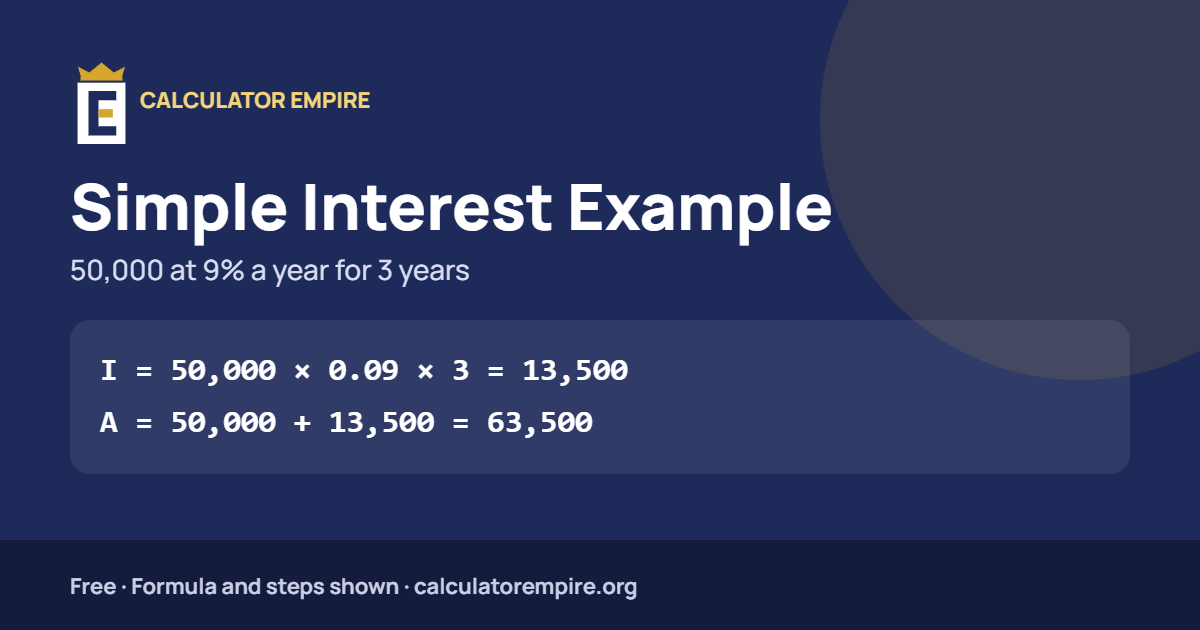
50,000 at 9% a year for 3 years:
- I = 50,000 × 0.09 × 3 = 13,500
- A = 50,000 + 13,500 = 63,500
Example 2 – days
The same 50,000 at 9% for 90 days: T = 90 ÷ 365 ≈ 0.2466, so I ≈ 50,000 × 0.09 × 0.2466 ≈ 1,109.59.
Example 3 – months
20,000 at 10% for 6 months: T = 6 ÷ 12 = 0.5, so I = 20,000 × 0.10 × 0.5 = 1,000.
Example 4 – finding the rate
You paid 13,500 interest on 50,000 over 3 years. R = 13,500 ÷ (50,000 × 3) = 0.09, so the rate was 9% a year.
Example 5 – finding the time
How long until 50,000 earns 4,500 at 9%? T = 4,500 ÷ (50,000 × 0.09) = 1 year.
Simple vs compound interest
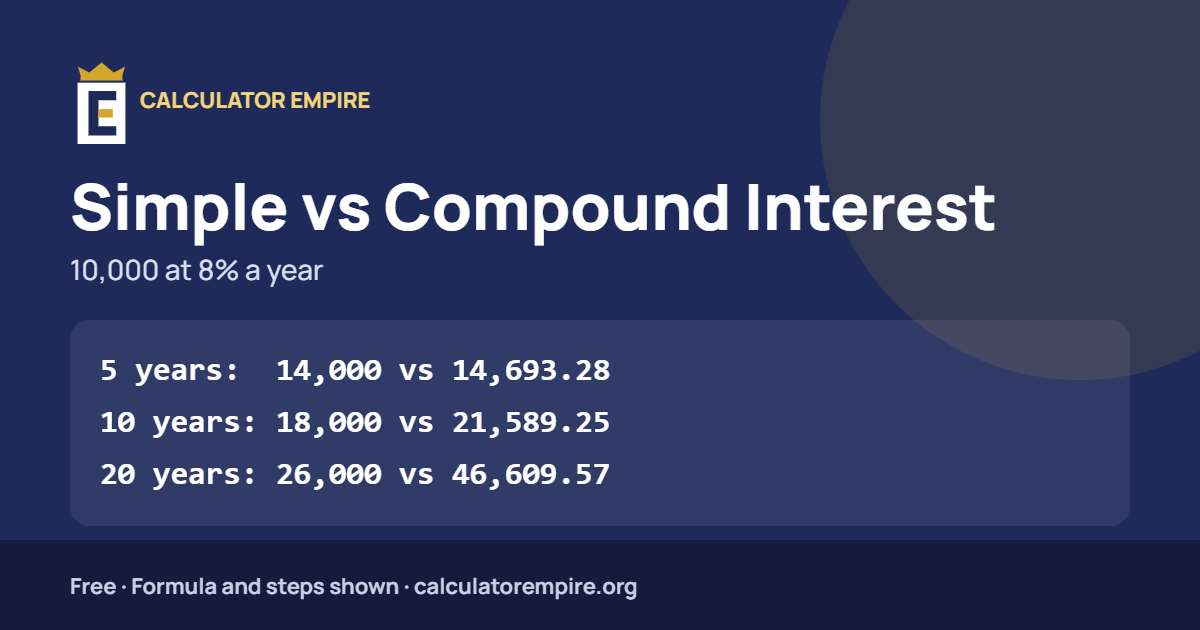
| Years | Simple interest (10,000 at 8%) | Compound interest (yearly) |
|---|---|---|
| 5 | 14,000.00 | 14,693.28 |
| 10 | 18,000.00 | 21,589.25 |
| 20 | 26,000.00 | 46,609.57 |
Simple interest is charged only on the principal, so it grows in a straight line. Compound interest also charges interest on interest, so it grows much faster over long periods – see the Compound Interest Calculator.
Where simple interest is used
- Short-term personal and payday-style loans.
- Some car loans, where interest is charged daily on the balance.
- Treasury bills and certificates that pay interest out.
- Late-payment interest on invoices.
- Maths and accounting exams.
Some banks use a 360-day year for daily interest. If your agreement says so, multiply the days result by 365 ÷ 360.
Frequently asked questions
What is simple interest?
Simple interest is interest worked out only on the original amount (principal), not on interest already earned or charged.
What is the formula for simple interest?
I = P × R × T, where P is the principal, R the yearly rate as a decimal and T the time in years. The total amount is A = P + I.
How do I calculate simple interest for months?
Divide the months by 12 to get years, then use I = P × R × T. For 6 months at 10% on 20,000: 20,000 × 0.10 × 0.5 = 1,000.
How do I calculate simple interest for days?
Divide the days by 365 (or 360 if your bank uses that convention), then apply the formula.
How do I find the rate of interest?
Rearrange the formula: R = I ÷ (P × T). Multiply by 100 to get a percentage.
Where is simple interest used?
Short-term personal loans, some car loans, treasury bills, and fixed deposits that pay interest out instead of adding it to the balance.
Is simple interest better for borrowers?
For the same rate and time, simple interest costs a borrower less than compound interest because interest is never charged on interest.
Is simple interest better for savers?
No. Savers earn more with compound interest, because the interest they earn also starts earning interest.
What is the difference between simple interest and a flat rate?
They are calculated the same way on the original amount. A flat-rate loan with monthly instalments costs more than a reducing-balance loan at the same quoted rate.
Can the simple interest calculator handle any currency?
Yes. Choose your currency from the list; the maths is the same in every currency.
Sources
Related calculators
- Compound Interest Calculator
- Loan Calculator
- Savings Goal Calculator
- ROI Calculator
- All Finance Calculators
Spotted an error? Tell us and we will check it.